
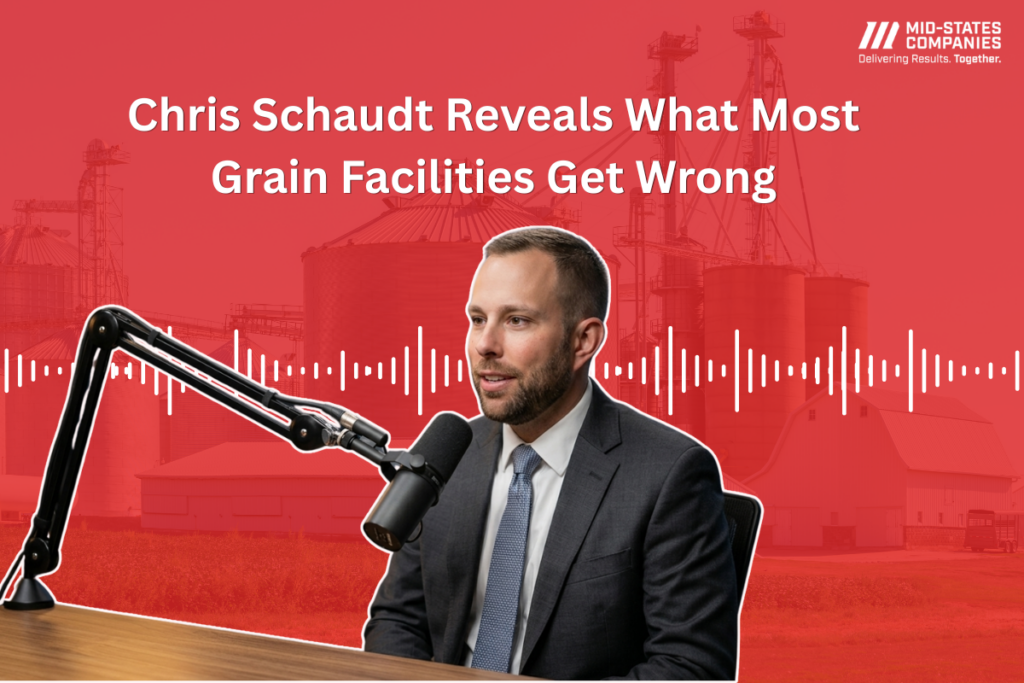
At Mid-States Companies, we have seen firsthand what separates a grain facility that performs
reliably for decades from one that constantly demands costly repairs and operational
workarounds. The answer almost always comes back to one thing: smart, experience-driven
planning done right from the start in our Grain Facility Design.
Chris Schaudt, our Vice President of Sales, recently sat down for an in-depth podcast
conversation where he shared practical insights from years of working alongside producers,
commercial grain operators, and facility managers. His focus was not on industry trends or
theoretical best practices. It was on how grain handling systems actually perform in the field,
and why long-term thinking is the most important investment a facility can make.
Understanding effective Grain Facility Design can lead to significant long-term savings.
Check out the podcast with Chris Schaudt
Designing for Longevity, Not Just Upfront Cost
One of the most common mistakes in grain facility design is optimizing for the lowest possible
day-one cost. While budget discipline matters, facilities that are rushed, undersized, or poorly
planned almost always create expensive operational problems down the road.
Chris explained that the most successful grain storage facility projects are not the cheapest
ones at groundbreaking. They are the facilities still running efficiently 10, 20, and even 30 years
later. At Mid-States Companies, we design every project as a complete operating system. Truck
flow, rail access, maintenance accessibility, safety protocols, automation integration, labor
efficiency, and future expansion capacity all factor into how a facility performs over its lifetime.
When grain handling systems are thoughtfully engineered from the start, customers see real
results: improved throughput, reduced downtime, and significantly lower long-term maintenance
cost
The Hidden Costs of Poor Grain Facility Planning
Many of the most damaging design problems do not show up on opening day. They surface
months or years later through recurring bottlenecks, inefficient traffic patterns, difficult
maintenance access, excessive labor demands, and unnecessary downtime during critical
harvest windows.
Consider a facility where truck receiving lanes were sized for current volume but not planned for
growth. Within five years, backups during peak harvest create hours of daily delay, increasing
labor costs and creating tension with producers who cannot afford to wait. A modest investment
in wider lanes or additional receiving capacity during the original grain facility construction would
have cost far less than the ongoing operational drag.
Small design decisions made early in a project carry long consequences. That is why we push
customers to ask harder questions during planning: What does your operation look like in ten
years? What happens when labor gets tighter? Can this facility adapt to higher speed
requirements or larger harvest volumes?
Why Experience Still Matters in Grain Facility Design
Every grain facility design project comes with a unique set of challenges. Geographic limitations,
regional weather conditions, specific commodity handling requirements, workforce realities, and
budget constraints all shape what the right solution looks like for a given customer.
Chris emphasized that the most important thing a designer or contractor can do is listen first.
Forcing a one-size-fits-all grain handling system onto a customer’s specific operation creates
friction from day one. At Mid-States Companies, we build solutions around each customer’s
operational goals, combining engineering expertise with practical field experience to help
customers avoid the design oversights that quietly drain profitability for years.
That experience is not just technical. It is relational. Successful grain facility construction
projects are built on trust, clear communication, and genuine long-term partnership. From initial
planning and engineering through construction management, installation, and ongoing service
support, we stay engaged across the entire project lifecycle.
How Automation Fits Into Modern Grain Handling
Systems
Technology is reshaping what modern grain facilities can do. Automation, advanced controls,
and real-time monitoring systems are creating new opportunities for operational efficiency and
visibility that were not possible a generation ago.
However, Chris was direct about one important point: even the most advanced automation
cannot compensate for weak facility fundamentals. Grain handling systems still require reliable
material handling equipment, efficient physical layouts, durable construction, safe workflows,
and practical maintenance access. Automation amplifies a well-designed facility. It cannot
rescue a poorly designed one.
Building Grain Facilities That Adapt to Future Demands
The grain industry is not standing still. Facilities being built today need to be capable of handling
larger harvest volumes, faster throughput requirements, reduced labor availability, increased
automation, and shifting transportation demands.
That is why we consistently encourage customers to think beyond their immediate operational
needs when planning grain storage facility projects. Infrastructure designed for long-term
adaptability costs more to think through carefully up front. It costs far less over the life of the
facility.
The facilities that hold their value and keep performing are not built by accident. They are the
result of disciplined planning, deep operational understanding, experienced engineering, strong
communication, and real partnership between the customer and the design team.
Ready to Design a Grain Facility Built for the Long Term?
At Mid-States Companies, we bring decades of field experience to every grain facility design
project, from small on-farm expansions to large commercial grain elevator construction. If you
are planning a new build, an expansion, or a modernization project, we would like to start with a
conversation about your long-term operational goals.
Contact us today to connect with our team and learn how we approach grain handling system
design built to last.
Frequently Asked Questions About Grain Facility Design
Q1. What are the most common mistakes made during grain facility design and
planning?
The most common mistakes include undersizing receiving capacity for future growth, ignoring
truck traffic flow during layout planning, and prioritizing low upfront cost over long-term
operational efficiency. Skipping proper planning for maintenance access and automation
integration also leads to higher labor costs and more downtime over time. Working with an
experienced grain facility design team from the start eliminates these problems before
construction begins.
Q2. How much does poor grain facility planning actually cost over time?
Poor grain facility planning rarely shows its true cost on day one. Over time it builds up through
harvest bottlenecks, inefficient layouts requiring excess labor, frequent equipment repairs, and
lost throughput during critical operating windows. In commercial grain elevator operations, even
a few hours of unplanned downtime during peak harvest creates significant financial losses.
Thorough planning upfront consistently delivers lower total cost of ownership over the life of the
facility.
Q3. When should automation be incorporated into a grain handling system design?
Automation should be planned during the initial grain handling system design phase, not added
after construction is complete. Building for automation from the beginning allows the layout,
electrical infrastructure, and control systems to integrate properly from the ground up.
Retrofitting automation into a facility not originally designed for it requires costly modifications
and rarely delivers the same efficiency gains.
Q4. How do I know if my existing grain facility needs an expansion or a full redesign?
If your grain storage facility is creating consistent harvest bottlenecks, struggling with throughput
demands, or requiring excessive labor to operate, it is time for a professional evaluation. A grain
facility assessment can determine whether targeted upgrades make sense or whether layout
and capacity limitations make a full redesign the smarter long-term investment. Your five to ten
year operational growth goals should drive that decision.
Q5. What should I look for when choosing a grain facility design and construction
company?
Look for demonstrated experience across grain handling system projects including new builds,
expansions, and modernization work. Ask for examples of facilities still performing efficiently
years after construction. Choose a partner who listens to your operational goals rather than
pushing standard solutions. The right grain elevator construction company stays engaged from
initial planning through long-term service support, not just through the build